QUALINEURO-REHAB study protocol published in BMJ Open: A milestone in pediatric neuro-cardiac rehabilitation
The QUALIREHAB Consortium celebrates a new scientific milestone with the publication of the official protocol for the QUALINEURO-REHAB multicenter randomized controlled trial in the open-access journal BMJ Open.
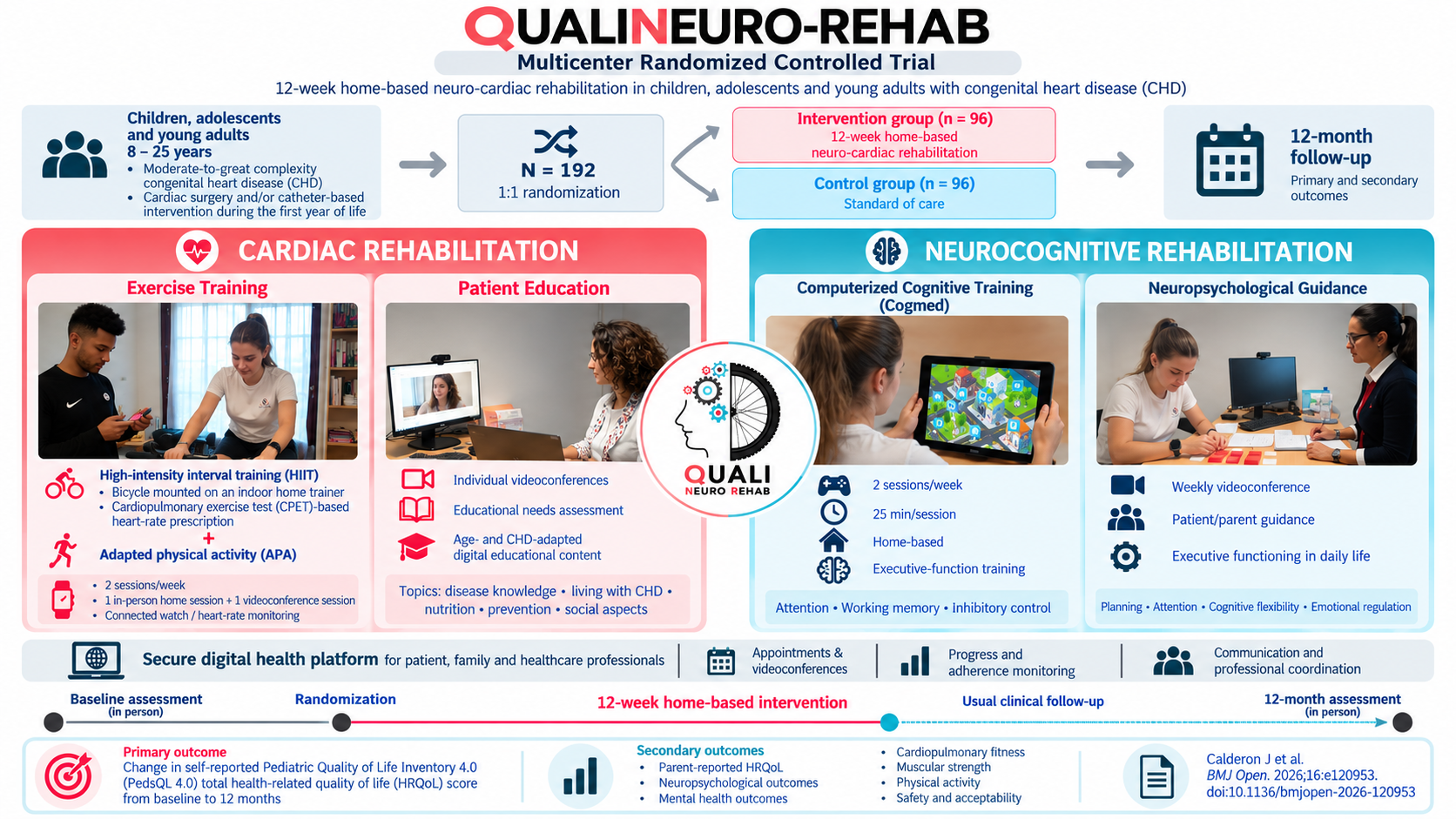
This pioneering trial evaluates a 12-week home-based hybrid neuro-cardiac rehabilitation program specifically designed for children, adolescents, and young adults aged 8 to 25 years living with complex congenital heart disease (CHD).
Training body and mind
The most common long-term challenges faced by survivors of early childhood heart surgery are physical deconditioning and neurodevelopmental impairments, particularly in executive function, attention, and self-regulation. To address both challenges simultaneously, the QUALINEURO-REHAB program combines two main intervention pillars delivered through a secure digital health platform:
Cardiac rehabilitation and adapted physical training
- Two weekly 1-hour sessions: one in person at home with an adapted physical activity specialist and one via videoconference.
- 30 minutes of high-intensity interval training (HIIT) on a customized stationary bicycle, based on each participant's baseline cardiopulmonary exercise test (CPET), plus 30 minutes of muscle strengthening and functional training.
- Therapeutic education modules for the patient and their family.
Neurocognitive rehabilitation and psychological support
- Two weekly 25-minute sessions of computerized cognitive training via the specialized CogMed platform, designed to improve working memory, attention, and inhibitory control.
- One weekly neuropsychological guidance session via videoconference to apply emotional regulation and executive function strategies to school, family, and daily life.
Objective
The primary objective of the trial is to demonstrate a clinically meaningful improvement in health-related quality of life (PedsQL 4.0 questionnaire) at 12-month follow-up compared with the control group receiving standard medical care. Secondary objectives objectively assess:
- Cardiopulmonary fitness: peak oxygen consumption (VO2peak) via cardiopulmonary exercise testing (CPET).
- Muscle strength and daily physical activity: handgrip dynamometry and ActiGraph accelerometers.
- Neuropsychological and mental health outcomes: executive functions (BRIEF, Wisconsin Card Sorting Test), memory, social cognition, as well as anxiety, depression, and resilience levels.
Trial progress and European collaboration
With a target enrollment of 192 participants randomized 1:1 between the intervention group and the control group, the trial has already enrolled 150 participants, demonstrating excellent execution across participating centers in France, Belgium, and Germany.
This collaborative research program is co-chaired and coordinated by Dr. Johanna Calderon (Inserm / Necker Children's Hospital) and Prof. Pascal Amedro (CHU de Bordeaux), bringing together a top-tier international consortium:
- Clinical centers and research institutes: CHU de Bordeaux, IHU LIRYC, INSERM, PhyMedExp, Cliniques universitaires Saint-Luc, Institut Saint-Pierre, CHU de Montpellier, AP-HP Necker–Enfants Malades, Deutsches Herzzentrum München, and Technical University of Munich (TUM).
- Technology partner: Anamnèse (e-health software development).
- Patient advocacy group: Association Petit Cœur de Beurre, which actively participated in designing the educational content and project materials.
Calderon J, et al. BMJ Open. 2026;16:e120953. https://doi.org/10.1136/bmjopen-2026-120953